Hungary’s political situation changed as much as any other state of the course of the 20th century. It cycled through two different monarchies, three republics, and two people’s republics in just under 100 years. Hungary was a part of the Austro-Hungarian Empire, one of the seven Great Powers of Europe before the first World War. It was part of the losers during the war, so its territory was carved up as seen fit by the victors. Hungary lost over 70% of its territory, including the entire modern-day country of Slovakia, the Western half of Romania, and the Northern part of Croatia, significantly reducing access to natural resources and its population. The loss of territory left Hungarian leaders bitter during the interwar period and left them yearning to reclaim what they thought of as their ancestral homeland. Before the Second World War, Hungarian politicians started to emulate the fascist policies of Germany and Italy, as both countries promised to restore the territory it had lost. Hungary joined the Axis powers in late 1940 due to mounting pressure from Germany on Prime Minister Pál Teleki and signed a short-lived treaty of friendship with Yugoslavia Hungary reluctantly aided the German-led invasions of Yugoslavia and the Soviet Union between 1941 and 1944 after the suicide of Teleki, who was subsequently replaced by László Bardóssy, a fanatical right-wing politician whose policies closely aligned with Nazi Germany’s. In 1944, Germany invaded and occupied Hungary as it feared Hungary would achieve peace with the Soviet Union independently, which would weaken its position on the Eastern Front. The Soviet Union liberated Hungary in 1945, but instead of allowing Hungary to install its own government, it imposed a Soviet-style communist regime that ensured Hungary would remain as part of the Eastern Bloc. The Eastern Bloc was the Soviet Union led, defensive alliance to counterbalance the power of NATO and was composed of the Soviet Union and its communist allies in Eastern Europe. Hungary tried to reform its political system in 1956, but was met with brutal repression from the Soviet Union. After this, Moscow’s grip tightened on Hungary to reassure its defensive alliance. As the Iron Curtain started to unravel, the Communist party in Hungary came with it. For the first time in almost 50 years, Hungary finally had elections in the spring of 1990.
Since founding the Fidesz party in the late 1980s, Orbán has been a staple in Hungarian politics. He became the president of the party in 1993 and became a Member of Parliament. In 1998, he formed a coalition with other right-leaning political parties and won the premiership, becoming Hungary’s second youngest Prime Minister at only 35 years old. His first term in office was highlighted by Hungary’s ascension to NATO, and economic measures to reduce unemployment and inflation through the abolition of university tuition fees and the reintroduction of paid maternity leave. His party lost in the 2002 election to the rival Hungarian Socialist party, so he served as the leader of the opposition from 2002-2010. In 2010, Fidesz won 53% of the national vote, but due to the representation system Hungary had, Fidesz won 68% of the seats in the National Assembly, giving it a supermajority. In Hungary, a supermajority in the National Assembly allows the ruling party to change the constitution unilaterally, and Fidesz did not hesitate to amend the constitution to entrench its power for the foreseeable future.
The first target for Fidesz was the constitutional court as it was the defender of government overreach since Hungary started to have free elections. In the original constitution, judges had to be approved by two-thirds of all members of the National Assembly. Fidesz changed the law so a judge could be voted in with two-thirds support from the ruling party, paving the way for Fidesz to pack the court with loyal judges that would not stop the party’s ambitions of staying in power. It also changed the number of judges from 11 to 15 so it could add 7 in the first year and a half. In Hungary, judges in the constitutional court are not elected for life, so loyalists can be continually voted in. With the court weakened, Fidesz created a situation where it could act with impunity. It changed the way elections were run by changing the Election Commission from a body that had delegates from each parliamentary party to only those who were in Fidesz. This allowed the party to effectively shape and control elections to achieve its desired outcomes. Orbán also targeted the media by instituting new laws that levied massive fines against outlets that did not have “balanced” coverage and installed a Fidesz loyalist as the head of the Media Authority. This action allowed his party to censure news outlets that were critical of his government or its policies. Finally, it limited the power of the Hungarian President who can issue a veto on laws to be sent back to parliament for revision and send laws of questionable legality to the constitutional court for review. With a loyalist installed, the supermajority in parliament could pass any law it supported. Orbán also gave away social benefits to increase party popularity shortly before elections. These benefits allowed the Fidesz party a short-term boost of popularity that gave it enough popularity among undecided voters to support the continuation of the regime. To ensure consistent electoral victories without an overwhelming majority of the vote share, Orbán reduced the number of people elected to the National Assembly from 368 to 199 to eliminate districts that traditionally voted in favor of opposition parties. His party was able to secure supermajority governments in 2014, 2018, and 2022 to elections through a combination of a rigged electoral system and favorable election commission. (Bánkuti, M., Halmai, G., & Scheppele, K.L. (2012). Hungary’s Illiberal Turn: Disabling the Constitution. Journal of Democracy 23(3), 138-146.
These compounding factors and the rapid entrenchment of Fidesz came at the expense of the Hungarian democratic institutions. From 2010-2020, Hungary fell 69 places in the Press Freedom Index, 11 places in the Democracy Index, 16 in the Corruption Perceptions Index, and was downgraded from Free to partly free according to the Freedom House Index. This has led to Hungary becoming the most corrupt country in the EU. Other sources have described Hungary as a hybrid regime or an elected autocracy. During his time in power, Orbán has also normalized relations with an increasingly aggressive Russia and strictly limited rights and censured depictions of LGBTQ+ people in Hungary. Orbán also funnelled money that is supposed to be used for public purposes into the pockets of his allies to ensure support and keep his grip on power.
The patience of the Hungarian people in both the government and private citizens wore thin with the ongoing corruption of the Orbán regime and calls for new leadership started to rise. Peter Magyar was a member of the Fidesz party until 2024, when he joined the Tisza party after the President of Hungary resigned over the cover-up of sexual abuse scandal against children. Magyar ran on a pro-European, anti-corruption campaign that aimed to course correct from the decade and a half of Orbán eroding the democratic institutions of Hungary. The popularity of Tisza had steadily risen since the start of 2025, while the popularity of Fidesz fell. In a final attempt to hold on to power, the Orbán regime intimidated voters to vote for his party through bribes or gifts of illicit drugs. A few weeks before the election, this information was revealed in a documentary and created by a team of independent journalists who worked for six months to expose his corruption. A week before the election, Vice President JD Vance visited Hungary and spoke at a campaign rally in support of Orbán’s reelection. Orbán is a key Trump ally in Europe and has been one of the few in Europe who consistently rallies for his support. (Ádám, Zoltán: Beating (Authoritarian) Populism with (Democratic) Populism: Orbán’s Anticipated Defeat and the Danger of Unlimited Single Party-Rule, VerfBlog, 2026/4/09, https://verfassungsblog.de/beating-populism-with-populism/, DOI:
The election date was set for April 12, 2026 with the national frontrunners being Orbán from the ruling Fidesz Party, and Magyar from the increasingly popular Tisza Party. Many across the world eagerly watched the race to see if Hungary would slide towards autocracy or prove that its democracy can still function as intended. On Sunday, a record 79% of eligible Hungarians voted in the election. Magyar and his Tisza party achieved a decisive victory, receiving 54.4% of the vote compared to the 37.8% Orbán saw. His party also gained a supermajority of 136 out of 199 seats in the National Assembly of Hungary. This election was the most consequential in modern Hungarian history and showed the power that people can have when they refuse to succumb to the pressure of autocracy. Even though Orbán quickly eroded the fabric of Hungarian democracy, the future is bright because Magyar is committed to remedying the deliberate actions of the previous regime.
Sources:
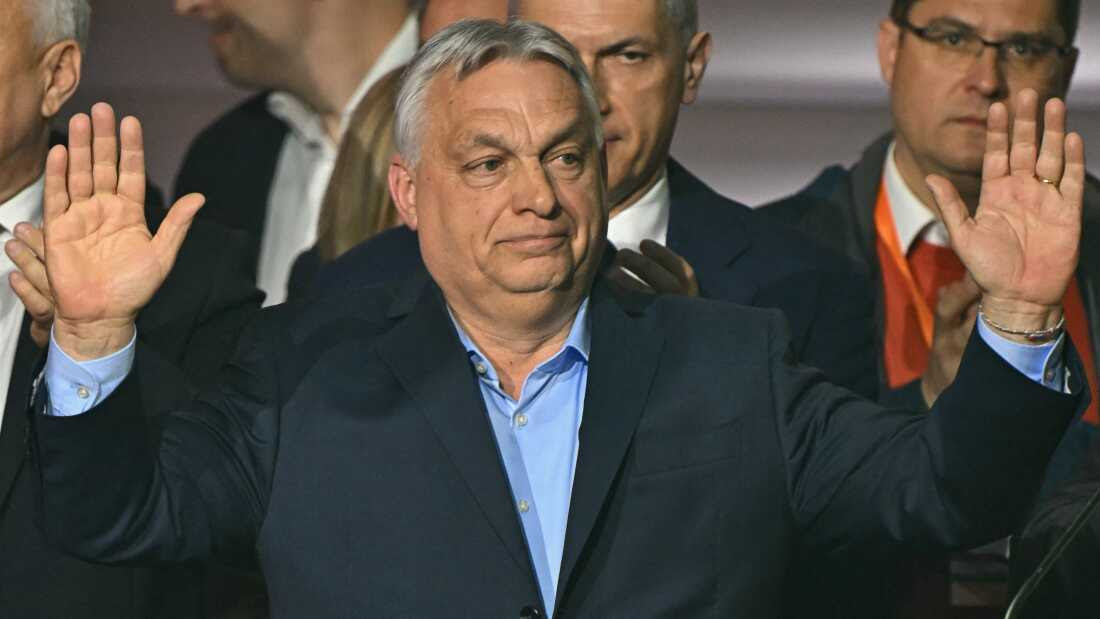
Image: Attila Kisbenedek/AFP via Getty Images
(https://www.politico.eu/article/hungary-election-results-peter-magyar-viktor-orban/).
(https://rex.libraries.wsu.edu/esploro/outputs/graduate/Of-monumental-importance-World-War-II/99900525111601842).
(https://www.populismstudies.org/wp-content/uploads/2021/03/ECPS-Leader-Profile-Series-1-2.pdf)
https://dx.doi.org/10.1353/jod.2012.0054. https://crd.org/vorban/, https://www.journalofdemocracy.org/articles/how-viktor-orban-wins/, https://www.osw.waw.pl/en/publikacje/analyses/2013-03-13/hungary-controversy-over-constitutional-changes)
https://freedomhouse.org/country/hungary/freedom-world/2026, https://rsf.org/en/country/hungary.
https://www.hrw.org/news/2025/06/20/pride-banned-hate-authorized-in-hungary)
Ádám, Zoltán: Beating (Authoritarian) Populism with (Democratic) Populism: Orbán’s Anticipated Defeat and the Danger of Unlimited Single Party-Rule, VerfBlog, 2026/4/09, https://verfassungsblog.de/beating-populism-with-populism/, DOI: 10.17176/20260409-173457-0.https://www.bbc.com/news/articles/c36r0068xp2o)