
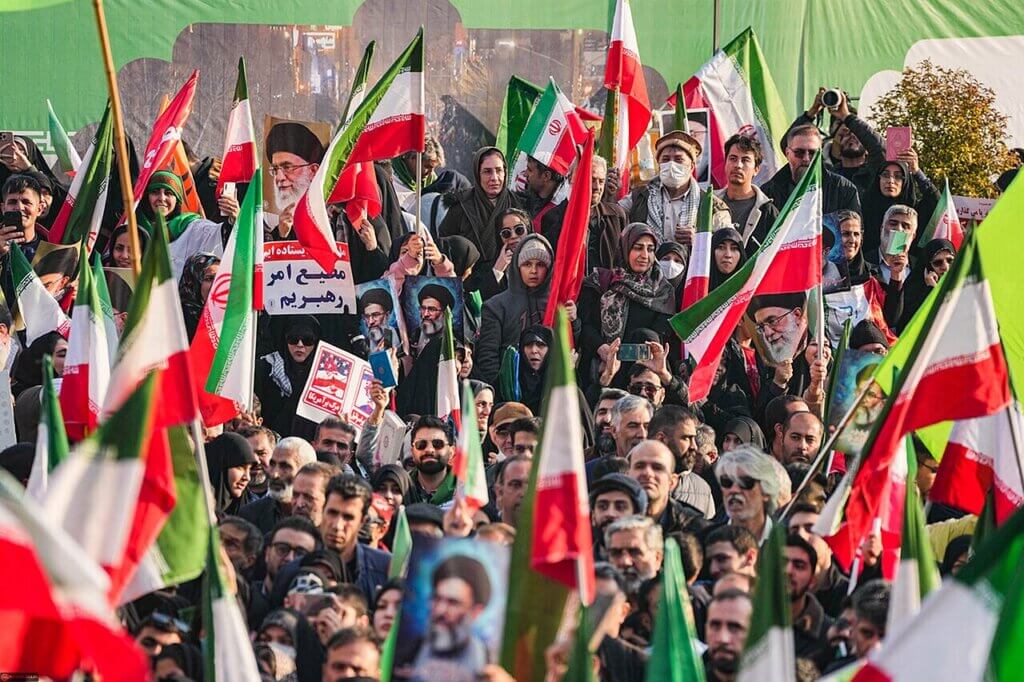
On December 28, 2025, shopkeepers in Tehran’s Grand Bazaar went on strike, closed their stalls, and moved into the streets. The protests began amid a severe fall in Iran’s currency, high inflation, and worsening living conditions. Food prices had jumped 72 percent year-on-year, and daily power shortages had become a regular struggle. This sparked the largest uprising since the 1979 Islamic Revolution, spreading to over 100 cities in all 31 provinces of Iran. Students from universities in Tehran, Isfahan, Yazd, and other areas joined the marches, shouting “Death to Khamenei,” “Neither Gaza nor Lebanon, My Life for Iran,” and “Seyyed Ali will be toppled this year.” What began as economic discontent quickly grew into a movement calling for an end to the Islamic government itself.
The nature of this uprising was different from the 2022 Woman, Life, Freedom movement. This time, young men had a more prominent role. Some chants expressed monarchist sentiments, aligning with exiled Crown Prince Reza Pahlavi’s increase in his political appeals to the international community. On January 8, Pahlavi called for unified protest, and by that evening, according to a European diplomat citing intelligence, 1.5 million people had taken to the streets of Tehran alone, with 5 million nationwide by January 9. At 8 p.m. that night, neighborhoods across Tehran burst into chanting, and then, almost at once, all communication to Iran was cut.
Iranian authorities imposed what sources described as the largest internet shutdown in the country’s history, isolating it from the outside world and making independent verification of events nearly impossible. Amid this blackout, the killing began. Amnesty International documented security forces on the streets and rooftops of mosques and police stations, firing rifles and shotguns loaded with metal pellets at protesters, often targeting their heads and torsos. Hospitals in Tehran and Shiraz became overwhelmed with gunshot victims. “They were shooting at everyone, anyone they could get their hands on,” a 73-year-old protester told NBC News. “Women, children, men, the elderly, the young, it made no difference to them.”
The death toll from January 8 and 9 remains one of the most disputed aspects of the crisis because the regime’s blackout was designed to keep the truth hidden. Iran’s government acknowledged 3,117 deaths, while the US-based Human Rights Activists News Agency published a list confirming 7,007 fatalities, with over 11,000 cases still under review. Two senior officials from the Iranian Health Ministry told journalists that the true toll from those two days could exceed 30,000. If accurate, this number would make those 48 hours the deadliest massacre of civilian protesters in recorded history. The Guardian reported that fewer than 10 percent of deaths may have been officially registered, with the state actively hiding casualties through mass graves and secret burials.
The concealment was systematic. CNN gathered testimonies from more than a dozen families who said they were pressured to falsify the circumstances of their loved ones’ deaths. Families were told to register slain protesters as Basij members or describe them as martyrs killed by foreign agents or claim they had died from overdoses or accidents. In some cities, authorities buried bodies themselves in undisclosed locations when families refused to comply, informing them only afterward. At the Kahrizak forensics center south of Tehran, videos showed families searching among piles of body bags. One Amnesty International analyst counted at least 205 body bags at a single makeshift overflow morgue.
The orders came from the top. The crackdown happened under the direct order of Supreme Leader Khamenei, who instructed the Supreme National Security Council to suppress the protests by any means necessary, with approval from all branches of government. Publicly, Khamenei accused protesters of acting on behalf of Trump, claiming they were destroying their streets to please Washington. The head of Iran’s judiciary vowed punishment would be “decisive and without leniency” and emphasized the need for speed on state television: “If we want to do a job, we should do it now. If it becomes late, two months, three months later, it doesn’t have the same effect.”
By late January 2026, the regime had mostly regained control of the streets. Over 50,000 people had been arrested. A government-organized rally in Valiasr Square attracted a noticeably small crowd, a stark contrast to previous years. However, the divisions exposed by the uprising were not easily smoothed over. The Economist reported that the violence had broken internal consensus within the Islamic Republic, with former presidents, senior clerics, and ex-officials publicly distancing themselves from the crackdown. Al Jazeera documented an open clash between ex-leaders and hardliners in the weeks after the killings, with former President Hassan Rouhani reportedly telling associates that the regime had crossed a line it could not return from.
With the streets quieted by force, the regime turned inward. Iranian security forces launched a campaign against the reformist movement, arresting Ebrahim Asgharzadeh, Mohsen Aminzadeh, and Azar Mansouri — senior members of the Reformists Front coalition — on February 8, followed by coalition spokesman Javad Emam on February 9. Their arrests were linked to a January reformist statement calling for Khamenei to resign and for a transitional governing council to take over. Nobel Peace Prize laureate Narges Mohammadi, already imprisoned, received an additional seven-year sentence. Doctors, lawyers, and journalists were also caught up alongside politicians. Protests continued to flare on university campuses, including at Sharif University of Technology, where students condemned Khamenei as a “murderous leader.”
Outside Iran, the diaspora mobilized on an unprecedented scale. On February 14, solidarity protests took place around the world. In Munich, police counted around 250,000 demonstrators waving pre-revolutionary flags and chanting “Change, change, regime change.” The European Union and Ukraine designated the IRGC as a terrorist organization. Australia imposed sanctions on twenty Iranian individuals and three organizations. US President Trump announced a carrier strike group was heading to the region, warning Iran directly that mass executions would not end well for them.
At the United Nations, concerns grew as executions seemed imminent. On February 27, UN Human Rights Chief Volker Türk called for an immediate moratorium on the death penalty in Iran, expressing horror that at least eight people — including two children — had received death sentences due to the protests, with another 30 at risk. A revolutionary court had already sentenced a man to death on charges of “enmity against God.” The UN’s Independent Fact-Finding Mission warned that tens of thousands of detainees faced torture, enforced disappearance, and expedited executions in violation of international due process. The Financial Times reported that Iran’s nuclear negotiators and Western counterparts were watching the protests with alarm, assessing how domestic unrest might affect stalled nuclear talks.
Diplomatic efforts collapsed. After a failed third round of indirect negotiations in late February 2026 and with Trump’s self-imposed 10-day deadline for a deal expired, US and Israeli strikes against Iran began on February 28, targeting the country’s leadership, security apparatus, nuclear sites, and missile installations. Supreme Leader Khamenei was killed in the opening attack on Leadership House. UN human rights experts condemned the strikes as violations of the UN Charter, warning that military intervention must not be seen as a solution to the Iranian people’s grievances and that US and Israeli calls for Iranians to “seize control of their own government” were reckless and endangered countless civilian lives. Iran launched retaliatory attacks against Israel and American bases across the region, escalating a conflict now involving more than a dozen countries.
The people who chanted in Tehran’s bazaars at the end of 2025 asked for electricity, for water, for a currency that could buy bread. Instead, they faced sniper fire, mass graves, and airstrikes. Whatever comes from the ruins of the Islamic Republic, those who survived will always remember the high cost of their demands.
Sources
Image: : REUTERS, Creator: Wa Lone
https://www.cnn.com/2026/02/26/middleeast/iran-protesters-crackdown-pressure-intl
https://news.un.org/en/story/2026/03/1167077
https://www.washingtonpost.com/world/2026/02/03/iran-protests-deaths-crackdown
https://www.bbc.com/news/articles/cd0y0ld39y0o